


Celebrating 75 Years of Stories in Renne Library
Evocative Photos, Compelling People, and Intriguing Tales from Renne Library's History
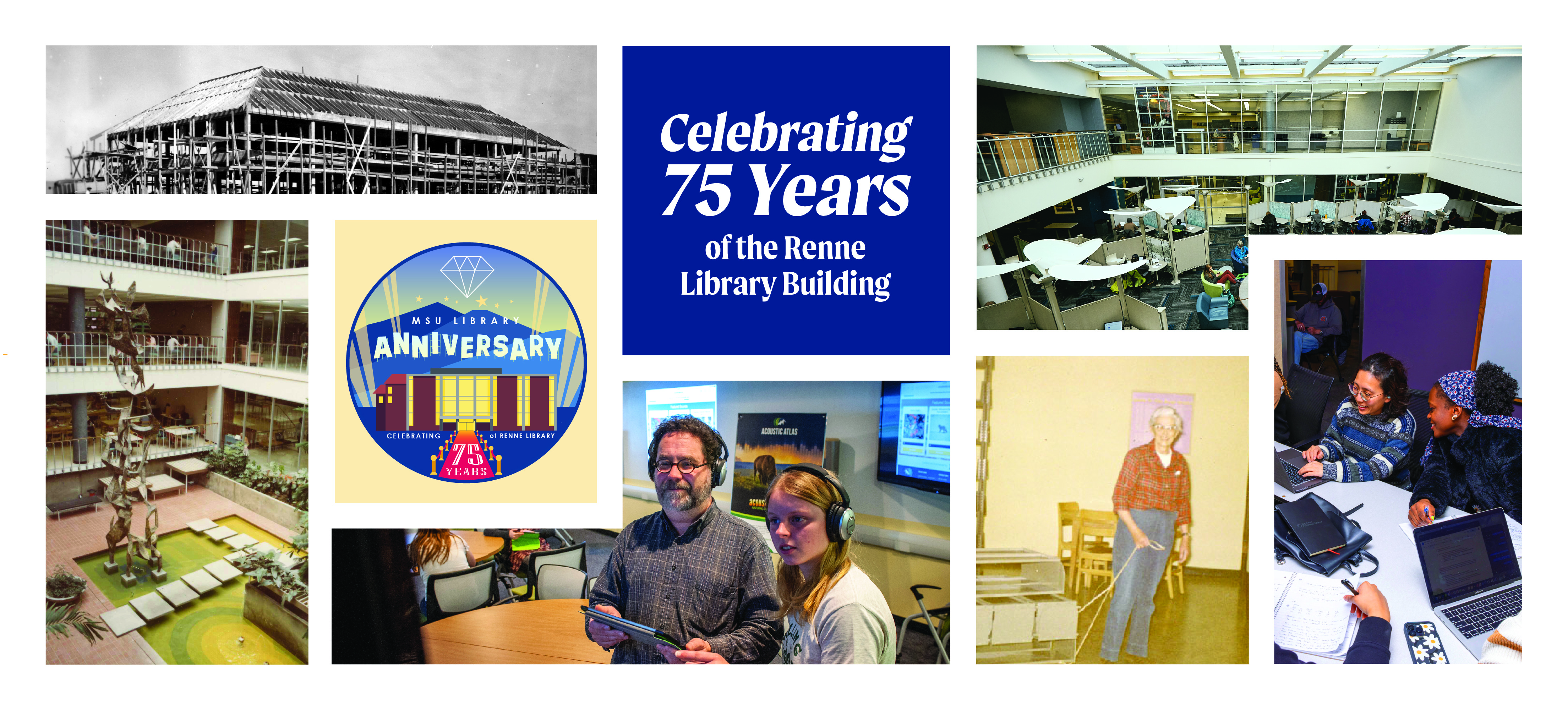
In celebration of the 75th anniversary of the Renne Library building, we bring you a collection of stories and images featuring some of the people who shaped our history and the evolution of our building, technologies, and collections.
Help us celebrate our history by sharing your library story. Is there a study spot you remember fondly? A librarian or staff member who helped you in your academic journey? A favorite book, technology, or service you found through the library? We'd love to hear about it. Click here to submit your story.
Learn About:

Early library days
When the Agricultural College of the State of Montana was founded in 1893, plans were made for a library. Although no librarian was available, funds were set aside to purchase books. The library’s collection was described as “small but carefully selected.”
From the earliest days of the institution, the library was enthusiastically received by the campus community. The December 1895 edition of the Exponent, the second-ever issue of the student newspaper, had positive things to say about the library.
“By degrees the college is acquiring a fine library, many of the books therein being the best procurable on these subjects; this together with files embracing more than a hundred of the leading agricultural publications and state papers are at the service of those attending college.” Click here to read the full story.
The original collection of library books was kept at Bozeman Academy and in Bozeman High School. Both were in downtown Bozeman and housed parts of the new college. Library materials were also held in a Quonset hut and a horse barn.
Hilma Sundell (1894-1895) and Sadie Shaw (1895-1896) were the earliest library employees. Both served as library assistants and were students enrolled in the “Ladies’ Course.” (The Ladies’ Course was a “domestic economy” program training women to become professional household managers who oversaw the “laws of life and health.”) Starting in 1896, Mabel Ruth Owens became the first full-time professional librarian to oversee the library's operations and collection development.
By 1896 the library had 2,600 volumes and 1,500 pamphlets and served the school's 50 students.


The move to Montana Hall
From 1927 to 1950, most library materials were held in Montana Hall while some remained in department libraries and other spots around campus. The top photo shows students studying at tables in Montana Hall in 1905. The bottom photo shows the tables as you find them today in the Archives and Special Collections Reading Room.

First talk of a library building
According to the library history compiled in 1967, Elizabeth Forrest, librarian from 1914-1929, was the first to mention the need to consolidate department library collections into a central library building. According to the history, “Her agitation was nipped in the bud by moving the library to the second floor of Montana Hall where at that time it had expansion possibilities.”
“Miss Forrest was known to faculty and students alike as ‘Pushbutton Liz’. Opinions as to how she earned this nickname vary. Some say it was because she used a small handbell to keep order; some say it was because she had a small pushbutton type noise; some say it was because she pushed the light switch to warn of the Library's closing.”
Lesley Heathcote’s 1967 library history


Holding nothing back in the fight for a library building
The conversation regarding a new library building continued with Lois B. Payson, library director from 1933-1939 and 1940 -1947. Once described as the “most pie-eyed optimist” who ever worked at the library, Lois was instrumental in furthering the conversation that resulted in the first library building for Montana State College.
Lois saw the challenges the college faced when it came to housing library materials and offering library services and created a Building Committee in 1939. The group outlined the need for a dedicated library building in their well-researched report, which included compelling facts and figures as well as anecdotes of falling ceilings, inadequate lighting, and this disparaging quote about the noise level in the Montana Hall library space.
”Did you know that noise in the library compares favorably with that in a boiler factory? The banging of pipes and radiators is terrific. The only salvation is the regularity of the banging and thumping. The floors creak and groan. Being in the library just before, during, and after class hour dismissal, a period of at least 30 minutes in each hour, is a strain on mind, nerves, and physical health.”
Lois and her committee worked to get a referendum to secure funds for a library added to the 1942 Montana ballot. Although the referendum failed, Lois and her successors never gave up, and in 1950 Montana State College opened its first library building. Lois was able to admire it when she retired and returned Bozeman in 1956.
“Mrs. Payson was a woman of active and inquiring mind
and attractive personality.”
Lesley Heathcote’s 1967 library history
Lesley Heathcote library champion
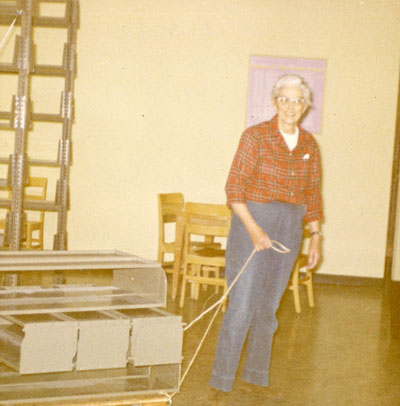
Lesley Heathcote was the library director from 1947-1970. She helped bring previous visions for a library building to life and was instrumental in the library’s 1961 expansion.
This photo of her hauling materials during the library expansion captures the hands-on nature of her leadership. Additionally, Lesley compiled the 1967 library history.
The library’s computer lab, the Heathcote Classroom, is named in her honor. Heathcote received an honorary doctorate from MSU in 1981.

Down the chute and into the library
At the end of 1949, the library prepared to move to its new building. A wooden chute was built into the Montana Hall fire escape, and homemade plywood boxes filled with books were dropped into the chute before landing in a truck waiting below.
The move to the new building took place over winter break (At some points in frigid weather!) and the registrar reported that “for weeks after the library was moved out, Montana Hall creaked and groaned as it readjusted to the lighter weight."
When the new building opened in 1950, the library had over 73,000 volumes. It was 8,894 square feet and served the school’s 2,771 students.
Dedicating space for Archives and Special Collections
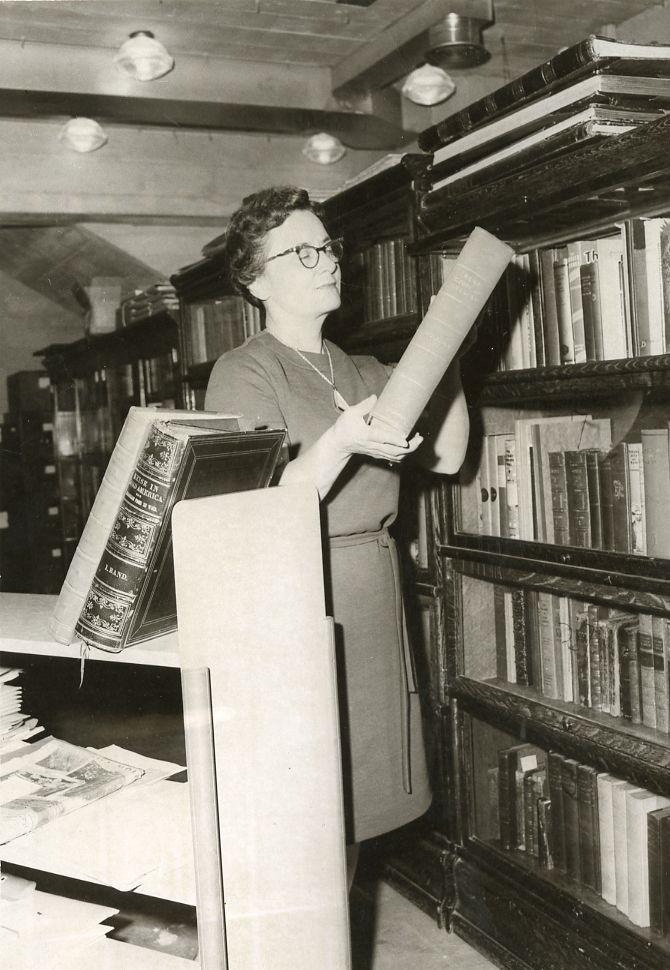
In the 1930s, the library began dedicating space for rare books. Later, in 1951, librarian Doris Wilson was asked to “evolve a policy for college archives,” and the scope of collecting historic materials expanded to include university publications. Rita McDonald, the library’s first archivist, was hired in 1954, and in 1962, the library formed a committee tasked with finding people throughout the state who might have materials of historic interest. Through these efforts as well as the work of Minnie Paugh, Special Collections Librarian from 1964 - 1984, archival collections at MSU Library grew extensively. In 1991, the Archives and Special Collections was named for Merrill G. Burlingame, who was a historian and an MSU professor, and the reading room was named for United States Senator Burton K. Wheeler.
Today, Archives and Special Collections holds both digital and physical collections telling stories of regional writers like Ivan Doig; Montana women’s history; the Greater Yellowstone Ecosystem; Montana’s agricultural history; and additional topics relating to MSU’s research interests. One of our most popular collections is the Trout and Salmonid Collection, the world’s largest and most comprehensive research center for information related to the study of these species.
Since MSU is a land grant institution, these collected resources are available to students, as well as researchers across Montana, the United States, and the world. A visit to the archives (whether virtual or in person) is a great way to step back in time. Collections containing historic MSU photos, MSU yearbooks, and the MSU Exponent are full of images and stories of students from the beginning of the institution, and the Picture Collection is a gateway to Montana towns and people dating back to 1827.
Archives and Special Collections can be searched online by clicking here and is open by appointment. You can visit this link to schedule a reading room appointment.

Before the click of a mouse came the flip of an index card
Before MSU Library had CatSearch, its online library catalog, students used the card catalog to search for books by author, title, or subject. Information was typed onto index cards, which were sorted alphabetically in stacks of labeled drawers. In Archives and Special Collections, we still use the card catalog to access the university history items not yet cataloged in other systems.
We love this photo from the 1990s, an era when it was necessary for researchers to use both the old card catalog and the new online catalog, called CatTrac, to find resources,
By 1997 the library offered seven different electronic resources including Brittanica Online and GPO Access, a source for government documents.

Making friends and looking ahead to a new century
Bruce Morton served as library dean from 1993 – 2007. Two landmarks happened during his tenure, the creation of the Friends of MSU Library group in 1994 and the library renovation in 2001. Today, the Friends group is still working hard to raise money and awareness for MSU Library, and its board of directors plays an active role promoting the library on campus and in the community.

Soaring to new heights
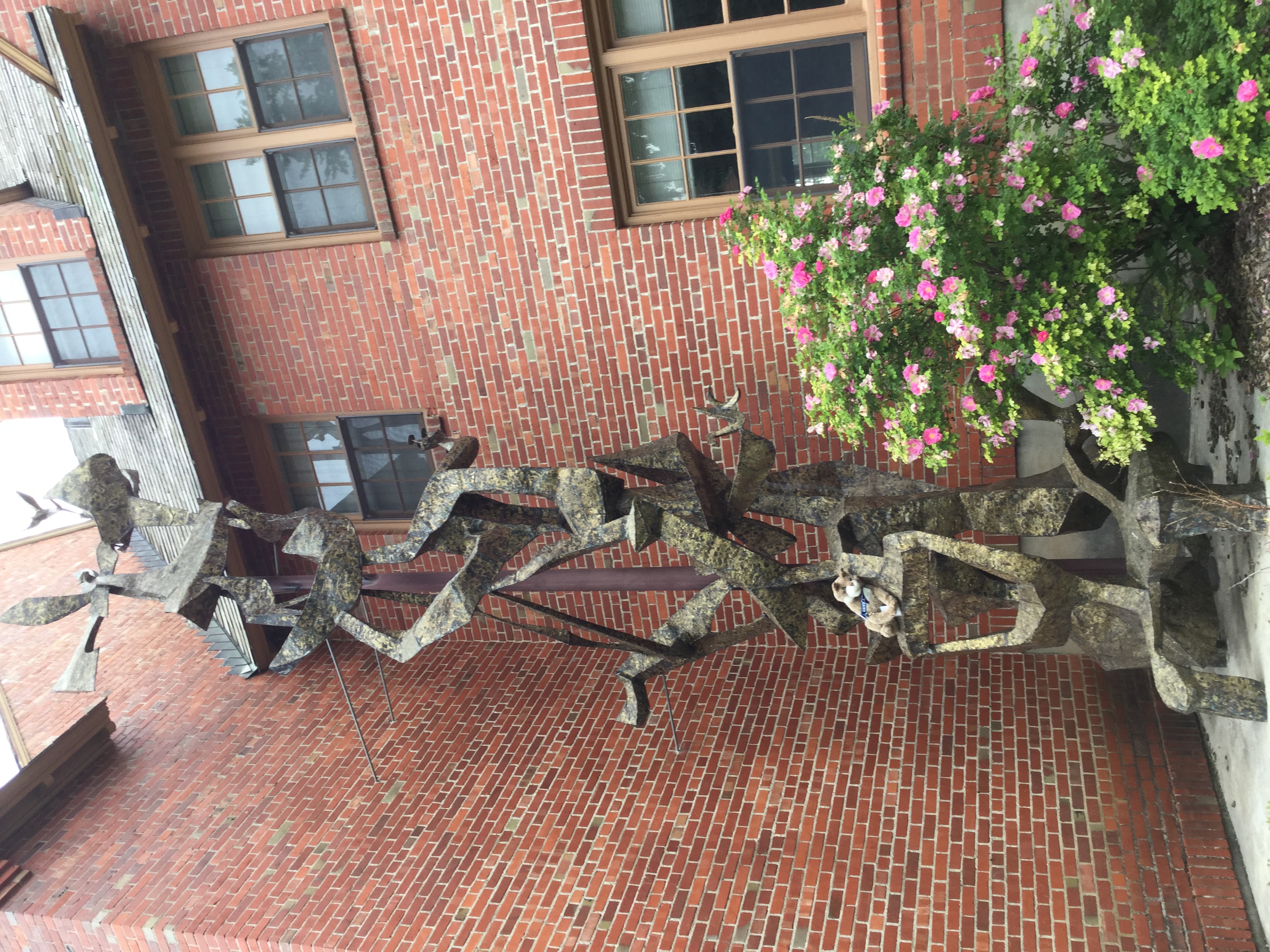
Before the 2001 renovation, the library lobby was known as Lesley Heathcote Court. The Fire Formed Sentinel sculpture, purchased with funds from the classes of 1960 and 1961, graced the lobby from 1962 until it was removed during the renovation. You can now find the sculpture in MSU’s Quads complex off Cleveland Avenue between South Sixth and Seventh Avenues.
Notice the tree in the lower right-hand corner of the old photo. According to the January 13, 1981 issue of the Exponent, this thirty-foot-tall Norfolk Island pine, one of the original items planted in the lobby as part of the 1961 library addition, became so top heavy it fell over. After careful analysis, an MSU horticulture specialist determined that the tree needed to be cut down. The day before Christmas the registrar’s office staff sang “Silent Night” (at the time they had a tradition of caroling on campus) in front of the tree as workers cut it down and unceremoniously carted it out of the library. You can click here to read the full story.
Putting student success first
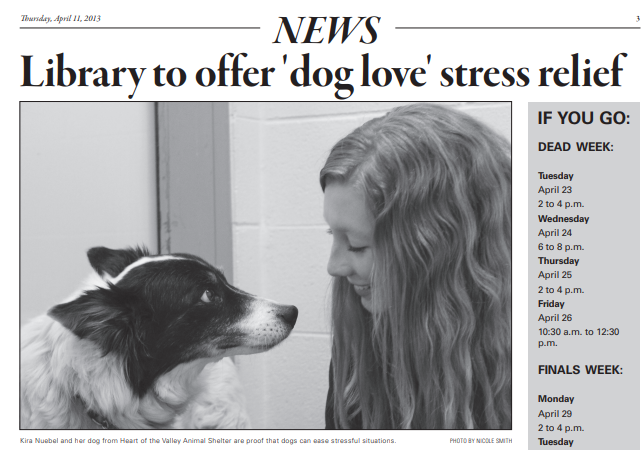
Student success has always been at the forefront of the library’s mission. Over the years this commitment has expanded beyond help with research and coursework and now includes programs and spaces dedicated to all aspects of student well-being. Some examples include the library’s Bobcat Browse enrichment reading collection, a game corner, a sensory seeking area, and stress relief events each semester. Our Paws to De-Stress partnership with Intermountain Therapy Animals began in 2012 and continues today.

MSU Library today
During its 75-year history Renne Library has transformed from a modest 8,894 square foot building into a four-story,112,000 square foot modern, innovative 21st century academic library. We provide 420 databases, over 400,000 print books, two million e-books, 240,000+ print and electronic journals, and hundreds of streaming videos severing more than 17,000 students.
Since Renne Library opened in the 1950, the nature of scholarly work and higher education has evolved into a much more collaborative process and MSU Library has adapted with the times. Today, MSU Library is the second busiest building on campus. Here you’ll find students collaborating in groups, brainstorming ideas on a whiteboard, socializing over coffee, and more.
Although academic libraries have changed, many of us remember the days of quiet libraries and “shushing” librarians. As we researched the early history of our library, we were surprised to discover that even decades ago it wasn’t always a staid and serious place. According to the 1967 library history, “Problems of order and quiet arose from the crowded library conditions. But in the report for 1940/41 Mrs. Payson called attention to the change brought about by the opening of the Student Union. For the first time, students had some other place than the library to do their visiting and dating.”
Whether you come to the library today to seek an interactive environment on the first and second floors, thrive in the solitude of the third and fourth floors, or access our online collections, MSU Library is YOUR library. While we are uncertain about how libraries will evolve in the next 75 years, we do know that MSU Library will remain dedicated to inspiring learning, sharing information, and connecting people.